

Gout: What It Is, Why It Happens, and How We’re Supporting It Naturally
Gout is one of those conditions that often gets minimized—until you experience it firsthand. The pain can be sudden, intense, and deeply disruptive, affecting mobility, sleep, and overall quality of life. At Dobermanor Farms, many of the remedies and products we develop come directly from real needs we experience here. Gout support is one of those needs.
Tony has lived with chronic gout for years, and this recent flare was particularly severe. Over time, he’s tried many expensive over-the-counter remedies with little success—often because they focused on a single angle instead of supporting the body as a whole. This experience led us to slow down, look at the bigger picture, and layer support intentionally.
This post shares what gout is, common symptoms and treatments, herbs that can help (and hurt), why remedies don’t work the same for everyone, and the specific protocol we used during this flare.
What Is Gout?
Gout is a form of inflammatory arthritis caused by a buildup of uric acid in the blood. When uric acid levels become too high (a condition known as hyperuricemia), sharp crystals can form and deposit in joints and surrounding tissues. These crystals trigger an intense inflammatory response.
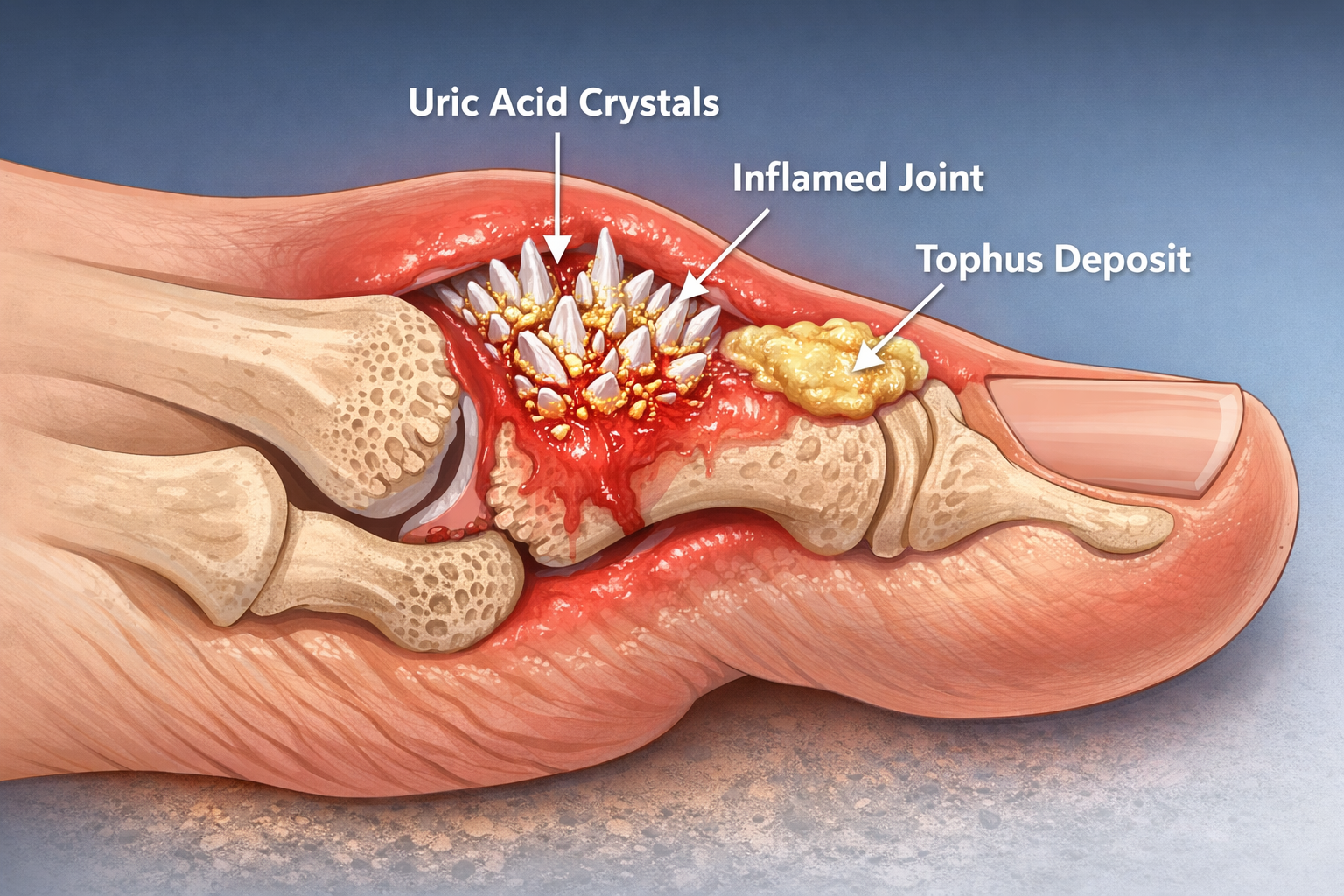
Inside A Gout Flare
Uric acid is produced when the body breaks down purines—compounds found naturally in the body and in certain foods. Normally, uric acid is filtered out by the kidneys and excreted in urine. Gout develops when uric acid production exceeds the body’s ability to eliminate it, or when excretion is impaired.
Common Symptoms of Gout
Gout flares often come on suddenly and may include:
Severe joint pain, commonly in the big toe (but also ankles, knees, wrists, or elbows)
Redness, warmth, and swelling
Tenderness so intense that even light pressure can be painful
Symptoms that peak within 24–48 hours and may linger for days or weeks
Many people describe gout pain as burning, stabbing, or throbbing, often waking them from sleep. People often complain that even the weight of a bed sheet touching the inflamed area is too much to handle.
Is Gout Hereditary?
Yes — gout and high uric acid levels have a significant hereditary component, largely because genetics strongly influence how efficiently the kidneys and gut handle uric acid.
What the research shows
Twin studies suggest the heritability of serum urate is substantial (often reported in the range of ~45–73%), meaning a large portion of uric acid level differences between people can be explained by genetics.
In addition to uric acid levels, traits related to urate handling (like renal urate clearance) also show strong heritability.
Large genetic studies (GWAS) repeatedly identify urate transporter genes such as SLC2A9 and ABCG2 as major contributors to gout risk.
Population studies also show familial aggregation of gout (it clusters in families more than would be expected by chance).
What this means in real life
Genetics don’t guarantee someone will develop gout — but they can load the deck by affecting:
how well uric acid is cleared
how easily crystals form
how sensitive the inflammatory response becomes
So if gout runs in the family, it’s not “just diet.” Diet matters, but genetics often explains why two people can eat similarly and only one gets gout.
Is Gout Related to Liver Health?
It can be related — not always directly, but through metabolic pathways that connect uric acid and liver health.
1) High uric acid and fatty liver are commonly linked
Multiple studies and meta-analyses show that higher serum uric acid is associated with nonalcoholic fatty liver disease (NAFLD).
Some research also suggests uric acid may play a role in mechanisms tied to fatty liver progression (like insulin resistance and liver fat accumulation), although causality is complex.
2) Gout/hyperuricemia can overlap with abnormal liver enzymes
A population-based study found people with hyperuricemia and gout had higher likelihood of elevated liver enzyme levels, which supports the idea that gout often travels with metabolic/liver stress.
3) Advanced liver disease and gout can complicate each other
In cirrhosis populations, researchers discuss how hyperuricemia can coexist with liver-related complications and metabolic issues; gout management may be more complicated in these patients.
Practical takeaway
If someone has chronic gout, it can be worth discussing screening labs with a clinician (especially if symptoms are frequent):
uric acid
kidney function
liver enzymes (ALT/AST/GGT)
metabolic markers (A1C, triglycerides)
Because sometimes gout is one piece of a bigger “metabolic picture.”
Approaches to Gout Care and Support
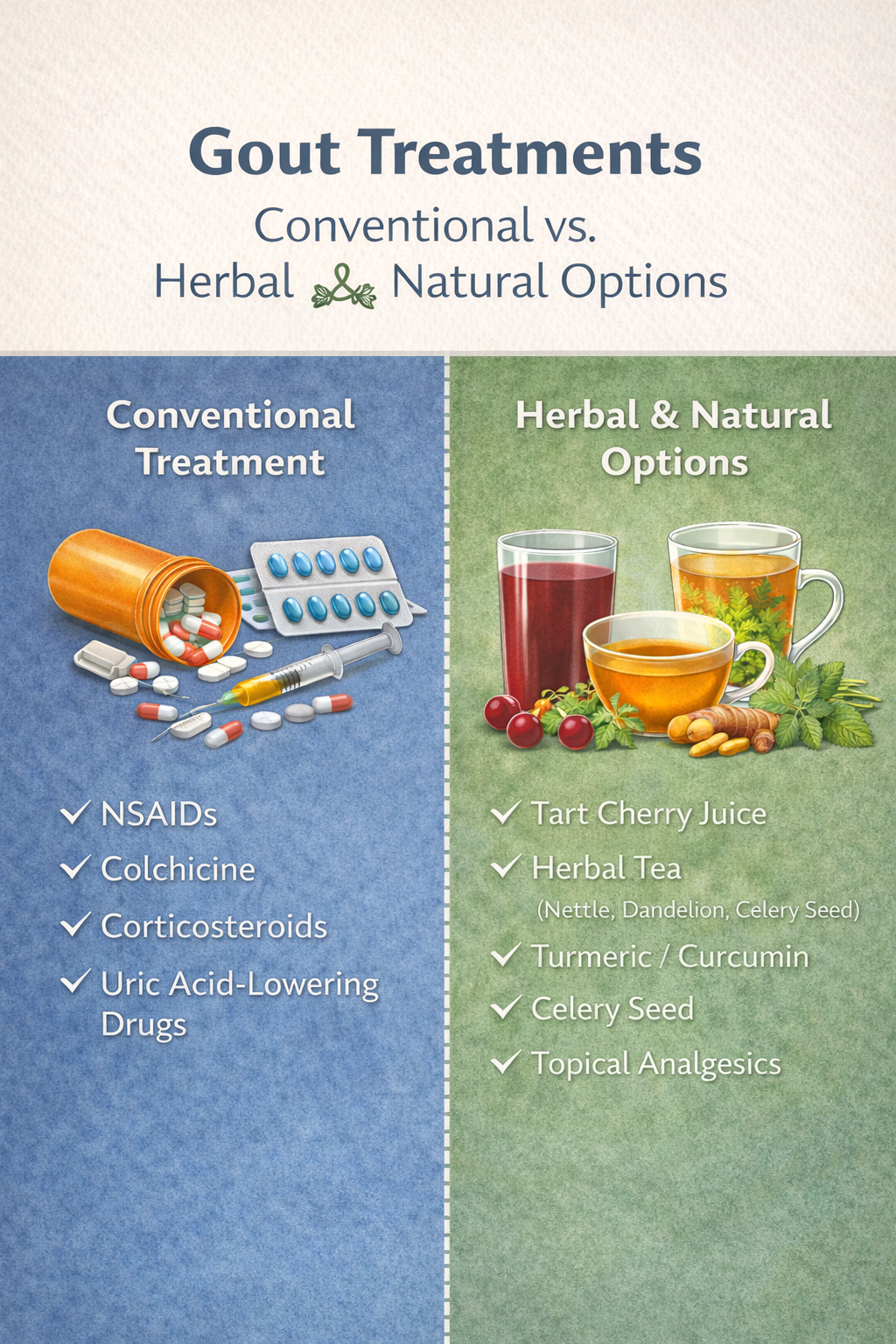
Gout Treatments
Convention vs. Herbal & Natural Options
Conventional Treatments for Gout
Acute Flares
Conventional medicine typically treats active gout flares with:
NSAIDs (nonsteroidal anti-inflammatory drugs)
Colchicine, which targets gout-related inflammation
Corticosteroids when other options aren’t tolerated
These medications aim to control pain and inflammation during an attack.
Long-Term Management
For people with frequent or severe gout, doctors may prescribe medications that lower uric acid levels, such as:
Allopurinol
Febuxostat
Uricosuric medications that increase uric acid excretion
Dietary changes, hydration, and lifestyle modifications are also commonly recommended.
Herbs That May Help With Gout Relief
Herbal support for gout generally works through a few key pathways:
reducing inflammation, supporting uric acid elimination, calming pain, and supporting kidney and metabolic function. Not every herb is appropriate for every phase of gout, and effectiveness varies from person to person.
Below are herbs most commonly discussed in traditional use and modern research.
Tart Cherry (Prunus cerasus)
Tart cherry is one of the most researched natural supports for gout. Studies suggest it may help reduce serum uric acid levels and lower the frequency of gout flares, likely due to its anthocyanin content and anti-inflammatory effects.
Celery Seed (Apium graveolens)
Celery seed has a long history of use for joint discomfort and gout. It contains compounds that may support uric acid excretion and help reduce inflammation. Whole seed, teas, tinctures, and standardized extracts are all commonly used.
Nettle Leaf (Urtica dioica)
Nettle is traditionally valued for its gentle diuretic action and kidney support. It may help the body eliminate excess uric acid while also offering anti-inflammatory benefits.
Turmeric / Curcumin (Curcuma longa)
Curcumin, the active compound in turmeric, is widely studied for its anti-inflammatory properties. While it does not lower uric acid directly, it can help manage pain and inflammation associated with gout flares.
Ginger (Zingiber officinale)
Ginger provides mild anti-inflammatory and circulatory support. In gout protocols, it is often used in small amounts, particularly during acute flares, to avoid excessive “heat.”
Dandelion Leaf (Taraxacum officinale)
Dandelion leaf is traditionally used to support kidney function and fluid balance. It may help promote uric acid elimination through gentle diuresis. (The root has different actions and is typically reserved for non-acute phases.)
Meadowsweet (Filipendula ulmaria)
Meadowsweet contains natural salicylates and has traditionally been used for joint pain and inflammation. It may offer pain relief similar to aspirin but should be used cautiously, especially by those sensitive to salicylates or using NSAIDs.
Devil’s Claw (Harpagophytum procumbens)
Devil’s claw has been studied for inflammatory joint conditions and may help reduce pain and stiffness. It does not address uric acid levels directly but may be helpful for symptom management in some individuals.
Boswellia (Boswellia serrata)
Boswellia is known for its anti-inflammatory effects on joints and connective tissue. It may help reduce swelling and pain without the gastrointestinal irritation associated with some NSAIDs.
Willow Bark (Salix alba)
Willow bark has traditional use as a pain reliever due to its salicin content. Like meadowsweet, it should be used cautiously and is not appropriate for everyone, especially those sensitive to aspirin.
Chanca Piedra (Phyllanthus niruri)
Often discussed in kidney and stone protocols, chanca piedra may support uric acid balance and kidney health. Research specific to gout is limited, but it is sometimes used in broader uric acid management strategies.
Milk Thistle (Silybum marianum) — Supportive, Not Acute
Milk thistle does not treat gout directly, but because gout often overlaps with metabolic and liver stress, liver-supportive herbs may play a role in long-term management. It is typically avoided during acute flares and used later for maintenance.
Research on herbal gout treatments is promising but still emerging. Traditional formulas like Qu-Zhuo-Tong-Bi have shown reduced inflammation in animal models and may hold value in broader complementary care.
Herbs and Remedies to Use With Caution
Not all herbs are supportive during an acute flare:
Fire cider or highly warming formulas—may aggravate heat and inflammation if used at peak pain.
Strong diuretics without adequate hydration—may stress the kidneys if not used carefully.
Some herbs like devil’s claw or cat’s claw show anti-inflammatory activity, but can interact with medications or have side effects, so they require caution and professional guidance.
A Note on Individual Response
Why Some Herbs Work for Some People (and Not Others)
This is one of the most important parts of herbal care: the “why” behind inconsistency.
A few reasons results vary:
Different drivers of hyperuricemia
Some people overproduce uric acid; many have under-excretion (kidney transporters). Genetics can influence this.Kidney function and hydration status
Diuretic herbs can help — or backfire — depending on hydration and kidney reserve.Inflammation intensity
During a severe flare, “warming movers” can make pain feel worse.Comorbidities (metabolic syndrome/NAFLD)
If gout is part of a metabolic cluster, support often needs to be layered and consistent.Product differences
One turmeric capsule is not the same as another (standardization, absorption aids, dose).
This is why layered, individualized support often works better than single-ingredient “miracle cures.”
Herbal care works best as part of a holistic plan that includes diet, hydration, lifestyle changes, and guidance from healthcare providers.
Our Approach at Dobermanor Farms
At Dobermanor Farms, we integrate real-world experience with thoughtful herbal choices. For acute gout support, we combine:
Cooling herbal tea (nettle, dandelion leaf, celery seed, fresh ginger)
Tart cherry juice for uric acid support
Turmeric curcumin for inflammation control
Topical analgesics for localized pain
This layered approach is based on traditional use and emerging evidence, rooted in what we’ve seen work over time.
Our Dobermanor Farms Gout Support Routine
Tony has dealt with chronic gout for years, and this flare was severe. Over time, he’s tried plenty of expensive OTC options that didn’t make a meaningful difference — often because they weren’t paired with the kinds of supports we now know matter most: inflammation control + uric acid support + kidney support, layered thoughtfully.
Here’s what we used:
1) Cooling Gout Support Tea (our base)
Ingredients (per 1 quart / ~4 cups):
2 Tbsp dried nettle leaf
1 Tbsp dried dandelion leaf (leaf, not root)
1 tsp whole celery seed, lightly crushed
3–4 thin slices fresh ginger (keep it light)
Directions:
Crush celery seed slightly.
Add celery seed + ginger to 4 cups cold water.
Bring to a gentle simmer and simmer 10–15 minutes.
Turn off heat, add nettle + dandelion leaf.
Cover and steep 20 minutes.
Strain.
How we used it:
1 cup, 3 times per day
Warm or room temp (not hot).
2) Tart Cherry Juice
We added tart cherry as a supportive tool because cherries have been studied for their relationship to gout flare frequency and serum urate levels.
How we used it:
8–12 oz/day, split into 2 servings (between tea doses)
3) Turmeric Curcumin Capsules (with black pepper)
We also used turmeric curcumin for inflammation support. Curcumin is widely studied for inflammatory pathways, and black pepper extract is commonly used to improve absorption.
How we used it:
1 capsule, twice daily with food
4) Topical Support for Pain
For localized relief, we added a high-potency Tiger Balm–style topical analgesic (external use). This didn’t replace internal support — it simply helped take the edge off while inflammation settled.
Final Thoughts
Gout is rarely a simple, one-cause condition, and there is no single remedy that works for everyone. Genetics, kidney function, metabolic health, lifestyle, and timing all play a role in how and when flares occur—and how the body responds to support. At Dobermanor Farms, our approach is rooted in real experience, careful research, and respect for the body’s natural processes. Rather than chasing quick fixes or relying on one product alone, we believe in layered, intentional support that addresses inflammation, elimination, and overall balance together. Whether someone chooses conventional treatment, herbal support, or a thoughtful combination of both, the goal is the same: relief, sustainability, and long-term well-being. As always, what we share is educational and born from lived experience—and we encourage working alongside qualified healthcare professionals to find the path that works best for each individual.
References
Arthritis Foundation. “Gout.”
National Institute of Arthritis and Musculoskeletal and Skin Diseases (NIAMS). “Gout.”
Centers for Disease Control and Prevention (CDC). “Gout.”
Dalbeth N, et al. The genetics of gout. Nature Reviews Rheumatology.
Li Y, et al. Serum uric acid and nonalcoholic fatty liver disease.
Zhang Y, et al. Cherry consumption and decreased risk of recurrent gout attacks. Arthritis & Rheumatism.
Healthline. “Natural Remedies for Gout.”
Hobbs C. Herbal Therapeutics Database – Gout.
FDA Disclaimer:
The information shared in this post is for educational purposes only and reflects our personal experience. These statements have not been evaluated by the Food and Drug Administration. This content is not intended to diagnose, treat, cure, or prevent any disease. Always consult with a qualified healthcare professional regarding medical conditions, medications, or treatment decisions.