
Sage Bundles or “Smudge Sticks”
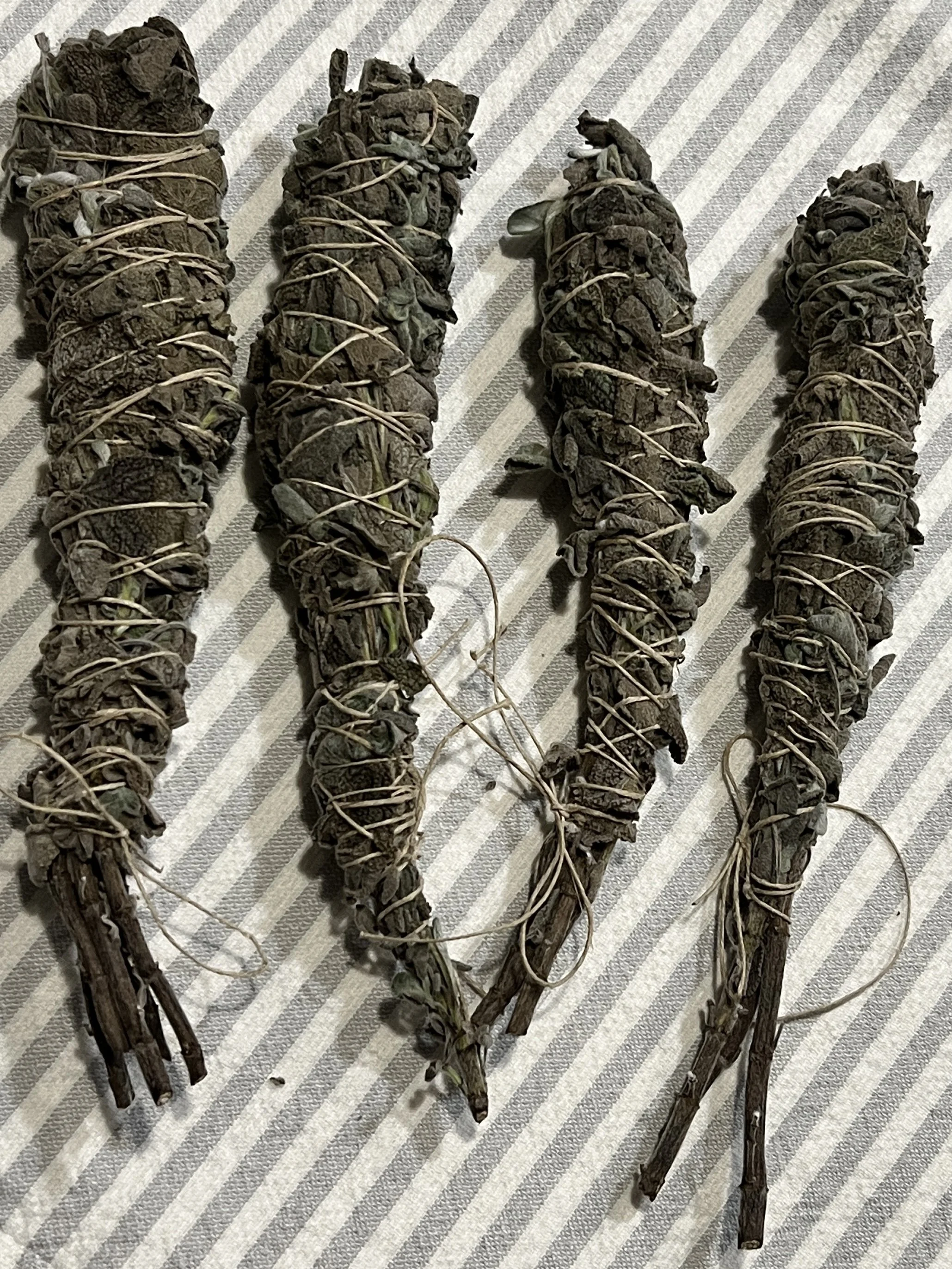
Hand-tied sage bundles (“Smudge Sticks”) from the Dobermanor Farms 2025 late-fall harvest.
Each stick is made from tightly bundled stems of Salvia officinalis, naturally dried and wrapped with simple cotton twine. The leaves have cured into a deep, earthy green-brown tone, showing the beautiful texture and curled edges that develop during slow air-drying.
The bundles vary slightly in size and shape — a natural result of handcrafting — with stems gathered at the base and leaves densely packed toward the top.
These bundles are available, in limited quantities, HERE!
Saging with Sage Bundles, Smudge Sticks, and Smoke-Cleansing: Heritage, Health, and Today’s Research
Sage bundles—often called “smudge sticks”—have been burned for centuries. “Smudging” is a sacred ceremony practiced by some Native American and First Nations peoples, using specific medicines (often sweetgrass, sage, and cedar) for prayer, purification, and blessing—always with cultural protocols led by Elders. These rites aren’t universal across all tribes, and the plants, prayers, and purposes vary by Nation. While the exact uses varied by region and culture, sage was valued for its strong aroma, preservative qualities, and protective role in the home. Using the word “smudging” outside those traditions can blur that reality, so I’ll use “smoke-cleansing” for general home practice and reserve “smudging” for referring to Indigenous ceremony. Wikipedia+1 While many people associate them with ritual, the practice also has deep roots in everyday, practical uses: preserving food, repelling insects, and keeping households healthier.
A note on white sage & ethical sourcing
White sage (Salvia apiana)—also called bee sage or California white sage—is native to Southern California and northern Baja and is culturally sacred to many tribes there. Today, it’s important to purchase cultivated sage or buy directly from Native growers to support ethical and sustainable use. Interest from mainstream wellness markets has pressured wild stands through poaching and habitat loss. Conservation groups list white sage on “at-risk” watchlists, and there have even been arrests tied to illegal harvest on preserves. If you use white sage, choose cultivated (not wild-foraged) bundles or purchase directly from Native growers. Better yet, grow your own or use regionally abundant alternatives (see below). United Plant Savers+2United Plant Savers+2 Cultivated sage or regionally grown herbs (garden sage, rosemary, lavender, thyme) are excellent alternatives.
Does burning herbs actually “clean the air”? Herbalist Perspective: What Science Says
Modern studies are starting to catch up with traditional knowledge. There’s intriguing (though limited) evidence that medicinal smoke can meaningfully reduce airborne bacteria in a closed space. Researchers believe the volatile compounds in sage and other herbs help decrease microbial load in the air. A 2007 study in Journal of Ethnopharmacology found medicinal smoke eliminated diverse plant and human pathogenic bacteria from the air after a one-hour burn, with effects that persisted for up to 24 hours in the tested room. That suggests an antimicrobial effect from certain plant smokes—think more “bioload reduction” than a total sanitizing solution. PubMed+1
The other side of the smoke
All indoor smoke also adds particulate matter (PM) to the air—the tiny stuff that can irritate lungs, trigger asthma, and isn’t ideal for kids, elders, or pets. Agencies and reviews on indoor air quality consistently note that burning anything indoors (incense, candles, cooking oils, herb bundles) elevates PM; ventilation and moderation are key. In short: smoke-cleansing is not “risk-free,” so make it occasional, brief, and well-ventilated.S EPA+1
Christianity & the Use of Fragrance and Smoke
For Christians who feel uneasy about “smudging,” it’s worth remembering that smoke and fragrance have long been part of biblical tradition:
Incense in worship: In Exodus 30, God commands Moses to prepare a holy incense of frankincense, myrrh, and spices, used in the Tabernacle as an offering.
Prayers rising like smoke: Psalm 141:2 – “Let my prayer be set forth before thee as incense; and the lifting up of my hands as the evening sacrifice.”
Purification by fire: Throughout Scripture, fire represents cleansing and God’s presence (e.g., Malachi 3:3; Acts 2:3).
Just as frankincense and myrrh were valued in biblical times for their medicinal and aromatic properties, sage can be understood in the same way: an herb of God’s creation, useful for health, cleanliness, and remembrance.
By framing sage in this light, Christians can approach it not as a mystical practice, but as a practical and historical use of God’s plants, much like burning incense in church or diffusing essential oils at home.
Plants & terms: sage vs. “sage”
White sage (Salvia apiana): Sacred to many Southern California tribes; strongly aromatic; please source ethically.
Common/garden sage (Salvia officinalis): Culinary sage many of us grow—excellent for home bundles.
Sagebrush (Artemisia spp.) (often called “prairie sage”): A different genus entirely, used by some Nations; don’t confuse it with Salvia. Homsted
Key Points to Remember
Sage has deep cultural roots in Native American heritage—respect that by sourcing ethically and acknowledging its history.
Scientific studies confirm sage smoke has antimicrobial effects, though moderation and ventilation are crucial.
For Christians, the use of aromatic smoke connects with biblical traditions of incense, purification, and fragrance offered to God.
Modern herbalists can embrace sage bundles as a way to refresh the air, honor heritage, and use plants practically—without the need for spiritual reinterpretation.
What We Offer
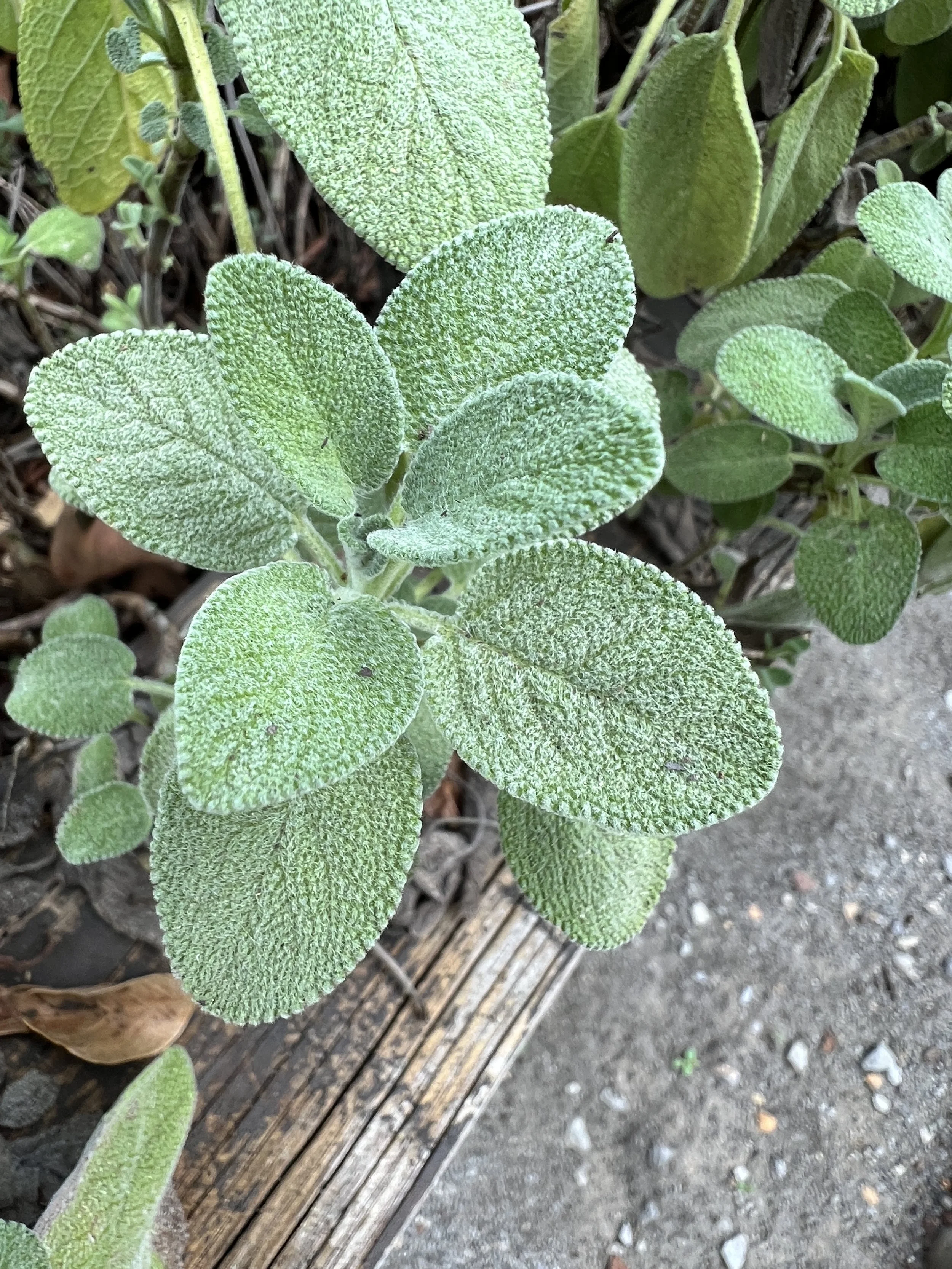
Here at Dobermanor Farms, we grow Salvia officinalis—better known as common or garden sage. This herb has been valued for centuries in kitchens and apothecaries alike. Its gray-green leaves are packed with volatile oils, making it aromatic, flavorful, and medicinal. Sage has been used to season food, preserve meats, soothe sore throats, and even freshen indoor spaces.
Dobermanor Farms is excited to begin offering a collection of sage-based goods:
Sage bundles (like the ones in our photo) – hand-tied and dried for safe home use.
Dried herb sachets – slip into drawers, closets, or pantries for freshness.
Simmer packs – combinations of sage and other herbs for stovetop simmer pots.
Hydrosols – distilled sage water sprays for gentle, smoke-free freshness.
Botanical Profile
Scientific name: Salvia officinalis
Family: Lamiaceae (mint family)
Appearance: Perennial shrub with woody stems, gray-green oval leaves, purple-blue flowers.
Growing conditions: Full sun, well-drained soil. Hardy in Zones 4–8.
Culinary Uses
Classic seasoning for meats, poultry, and stuffing.
Blends well with rosemary, thyme, and garlic.
Infused in butter or olive oil for sauces.
Medicinal Uses (traditional & researched)
Antimicrobial: Contains thujone, camphor, and cineole; used historically to combat infections.
Digestive aid: Bitter principles stimulate appetite and digestion.
Respiratory: Sage tea was a traditional gargle for sore throats and coughs.
Cognitive support: Recent studies suggest sage extracts may enhance memory and focus.
Aromatic & Household Uses
Sage bundles and loose leaves burned (in moderation, ventilated) for air freshness and bacterial reduction (supported by studies like Nautiyal et al., 2007).
Dried leaves stored in pantries to deter pests.
Hydrosols and sachets for natural fragrance without smoke.
References & further reading
On ceremony and respectful language; overview of smudging protocols and diversity across Nations. Wikipedia
The Four Sacred Medicines (sweetgrass, sage, cedar) in Indigenous contexts. Anishnawbe Mushkiki
White sage conservation status and “At-Risk” watchlist (United Plant Savers, 2022 list & profile). United Plant Savers+1
Illegal wild harvest/poaching incidents and ethics of sourcing. United Plant Savers
Antimicrobial effects of medicinal smoke (Journal of Ethnopharmacology, 2007). PubMed
Indoor smoke & particulate matter guidance (US EPA) and incense smoke health review. US EPA+1
Nautiyal, C. S., Chauhan, P. S., & Nene, Y. L. (2007). Medicinal smoke reduces airborne bacteria. Journal of Ethnopharmacology, 114(3), 446–451.
U.S. Environmental Protection Agency. (2021). Indoor Air Quality and Smoke.
Chuang, H. C., et al. (2013). Exposure to incense burning, respiratory symptoms and lung function in adolescents. European Respiratory Journal, 41(6), 1388–1395.
United Plant Savers. (2022). At-Risk Species List: Salvia apiana.
Exodus 30; Psalm 141:2; Malachi 3:3; Acts 2:3 – The Holy Bible.