

Milk Thistle - The Thorned Guardian of the Field
There are plants that gardeners intentionally cultivate with care — tucked neatly into raised beds, watered faithfully, protected from pests, and admired for their beauty.
And then there are plants like milk thistle. Milk thistle does not ask permission to grow.
It rises from gravel drives, forgotten corners, old fence lines, and disturbed soil with sharp leaves and towering stalks, armed with enough spines to discourage nearly anyone from touching it carelessly. Most people call it a weed long before they ever learn its name.
But herbalists have spent centuries viewing milk thistle differently.
Beneath those armored leaves and thorned flower heads lies one of the most respected traditional liver-supportive herbs in Western herbalism — a plant whose reputation survived not only folk medicine, but eventually drew the attention of modern scientific research as well.
And once you begin learning about milk thistle, it becomes difficult to see it as “just a weed” ever again.
Meet Milk Thistle
Common Name
Milk Thistle
Scientific Name
Silybum marianum
Family
Asteraceae (Daisy Family)
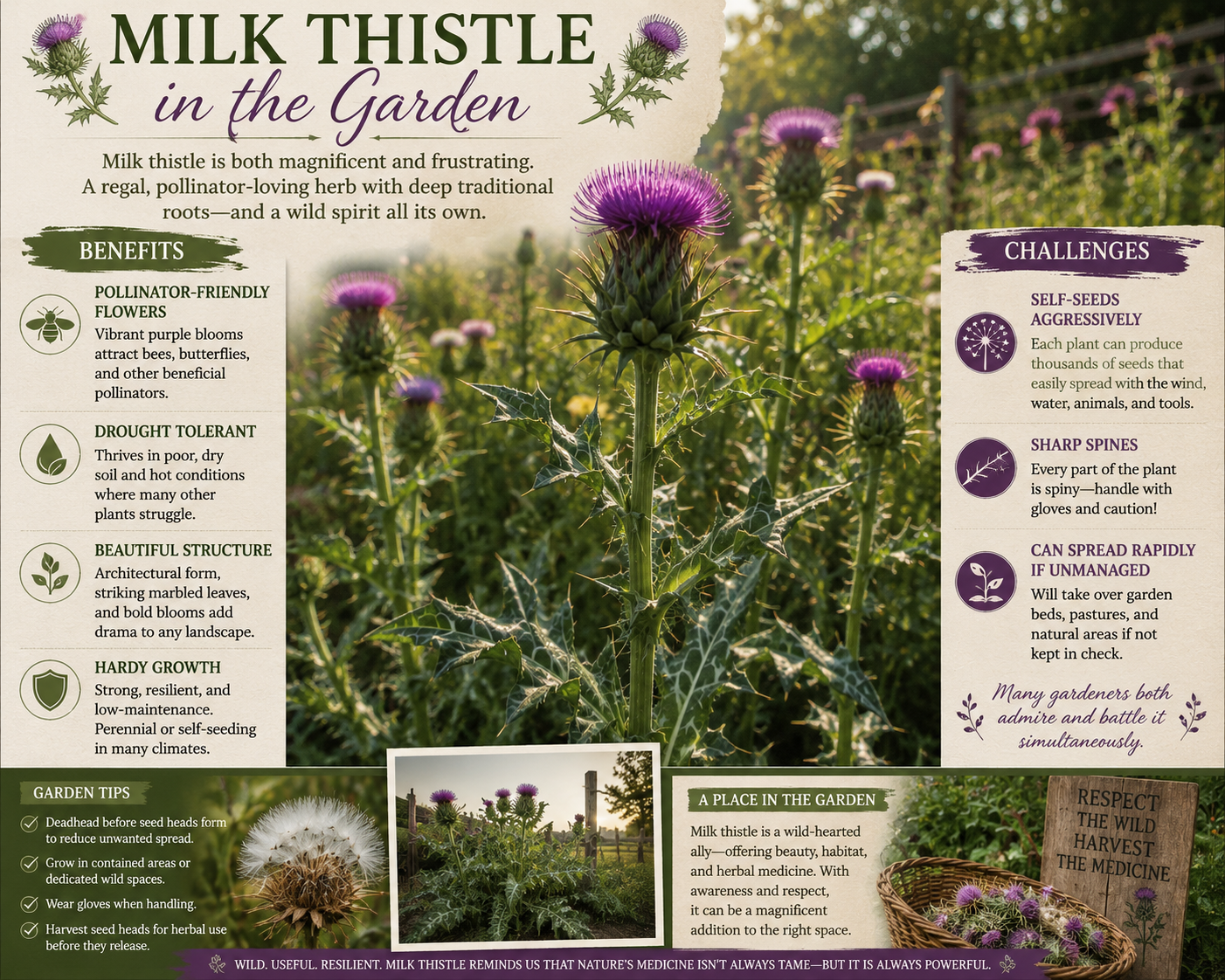
Milk thistle is native to the Mediterranean region but has naturalized across much of North America. In many rural areas, it appears almost effortlessly.
It thrives in:
Disturbed soil
Roadsides
Pastures
Dry open fields
Fence rows
Waste areas
Sunny neglected spaces
Ironically, some of herbalism’s most respected plants seem drawn to difficult ground.
Milk thistle is one of them.
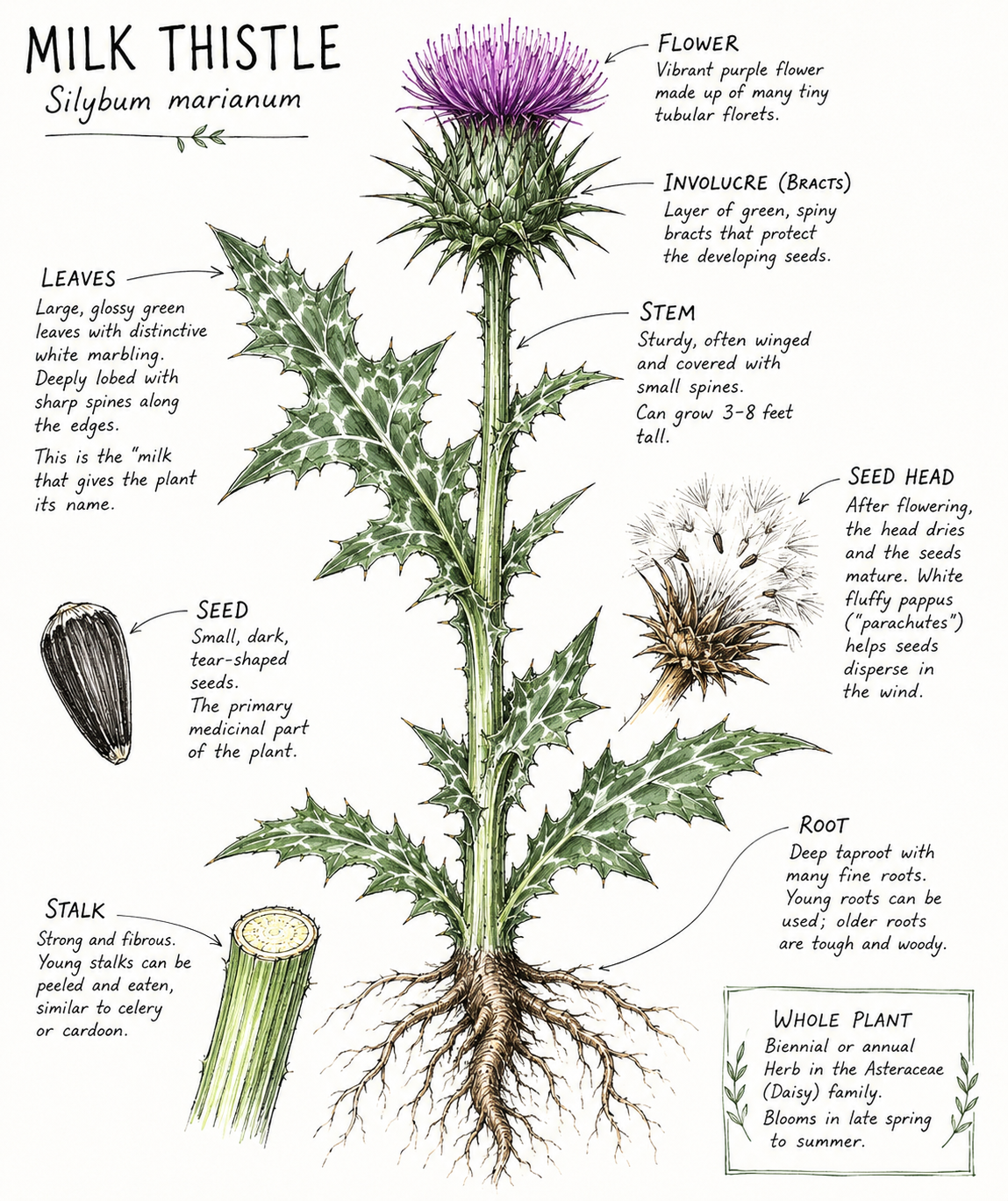
Why Is It Called “Milk” Thistle?
The answer lies in the leaves.
Milk thistle’s glossy green foliage is streaked with dramatic white marbling that looks almost hand-painted. According to old Christian folklore, the markings came from drops of the Virgin Mary’s milk falling onto the plant while hiding with the infant Jesus.
Whether viewed spiritually, symbolically, or simply as folklore, the story remained attached to the plant for centuries and gave rise to the name “milk thistle.”
The leaves themselves are unforgettable:
Deep green
Glossy
Jagged
Splashed with white veins
Protected by sharp spines
Beautiful enough to admire.
Sharp enough to punish carelessness.
A Plant Built for Survival
Milk thistle is not delicate.
Mature plants can grow:
3–8 feet tall
Several feet wide
Thick-stemmed and sprawling
Crowned with vivid purple flowers
The leaves are heavily armored, and nearly every part of the plant carries formidable spines.
Yet despite its aggressive appearance, milk thistle became associated for centuries with restoration and protection.
That contrast feels meaningful somehow.
A harsh-looking plant becoming known for support and resilience.
Historical Herbal Use of Milk Thistle
Milk thistle has a long history in European herbal traditions dating back to ancient Greece and Rome.
The Greek physician Dioscorides referenced thistle-like plants medicinally as early as the first century. Later European herbalists, including Nicholas Culpeper in the 1600s, described milk thistle as supportive for the liver, spleen, and digestive complaints.
Historically, milk thistle was associated with:
Liver support
Gallbladder wellness
Digestive sluggishness
“Melancholy”
Recovery after illness
General restorative tonics
Traditional herbal systems often linked liver health to:
Skin clarity
Digestion
Mood
Energy
Hormonal balance
Overall vitality
Milk thistle became one of the classic herbs associated with supporting those systems.
The Seeds: The Most Valued Part
While multiple parts of milk thistle are edible or usable, the seeds are the primary medicinal portion used in modern herbalism.
The seeds contain a complex of flavonolignans collectively referred to as silymarin.
Major components include:
Silibinin (also called silybin)
Silychristin
Silydianin
These compounds are responsible for much of the modern scientific interest surrounding milk thistle.
Milk Thistle and Liver Support
The liver performs hundreds of critical functions within the body, including:
Filtering compounds from the blood
Metabolizing medications
Processing hormones
Supporting digestion through bile production
Managing nutrient storage
Assisting detoxification pathways
Traditional herbalists viewed milk thistle as a protective and restorative ally for overworked systems.
Modern scientific research has heavily focused on milk thistle’s relationship to:
Oxidative stress
Liver cell protection
Inflammatory pathways
Metabolic health
Milk thistle remains one of the most extensively studied traditional liver herbs in modern herbal research.
Clinical studies have explored its potential role in:
Liver enzyme support
Fatty liver disease research
Alcohol-related liver stress
Oxidative damage
Metabolic syndrome
Type 2 diabetes support
Research continues today, particularly surrounding silymarin and its antioxidant properties.
Milk Thistle and Oxidative Stress
One of the major reasons researchers remain interested in milk thistle is its antioxidant activity.
Oxidative stress occurs when unstable molecules known as free radicals outnumber the body’s antioxidant defenses. Over time, this imbalance may contribute to cellular damage.
Silymarin has been studied for:
Free radical scavenging activity
Cellular protection
Membrane stabilization
Support of glutathione activity
This antioxidant relationship is one reason milk thistle became associated historically with “protection” and “restoration.”
Modern Research Into Metabolic Health
Beyond liver research, modern studies have also explored milk thistle’s role in:
Blood sugar balance
Lipid metabolism
Insulin resistance
Metabolic inflammation
Some systematic reviews and meta-analyses suggest possible supportive effects on metabolic markers, though research is still evolving.
This growing area of study reflects a broader understanding that liver function and metabolic health are deeply interconnected.
Milk Thistle in Traditional Herbal Formulas
Milk thistle is rarely viewed as a “solo hero” herb in traditional herbalism.
Instead, it is often paired with herbs that complement its actions.
Classic pairings include:
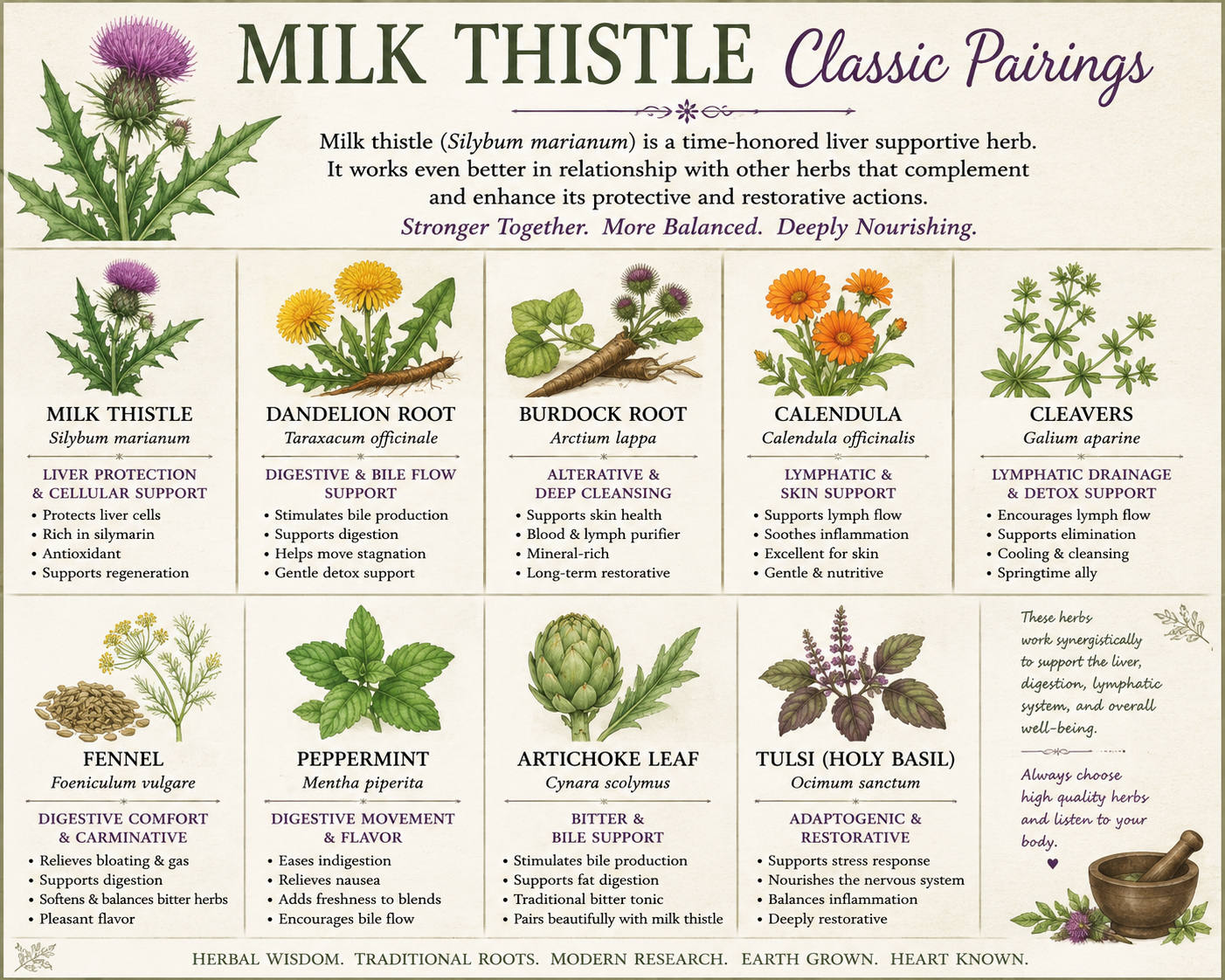
These combinations create formulas that feel more balanced, nourishing, and holistic.
Edible Uses of Milk Thistle
Many people never realize milk thistle is also edible.
Young Leaves
When harvested young and carefully trimmed of spines:
Leaves may be cooked like greens
Added to soups
Used similarly to spinach
The flavor is mildly bitter — common among traditional liver herbs.
Stalks
The peeled inner stalk can be eaten raw or cooked. Some compare it to celery or cardoon.
Roots
Young roots were historically roasted or cooked, though this use is less common today.
Harvesting Milk Thistle
Seed Harvest
The seeds are usually harvested:
Late summer
Into early fall
Once flower heads begin drying
Signs they are ready:
Flower heads turn brown
White fluff appears
Seeds loosen easily
Wear gloves.
Milk thistle is not forgiving to bare hands and sometimes even gloved hands.
Basic Harvest Process
Cut mature flower heads
Place in paper bags
Allow to dry fully
Separate seeds carefully
Store in airtight containers
Whole seeds store better than powdered seeds.
The Symbolism of Milk Thistle
The more time spent around medicinal plants, the harder it becomes not to notice patterns.
Milk thistle thrives where the soil has been disturbed.
Where conditions are harsh.
Where other plants struggle.
And somehow, hidden beneath all those spines, is a plant associated for generations with protection and restoration.
Maybe that is part of why herbalists have respected it for so long.
Some medicines arrive soft and comforting.
Others arrive armored.
Milk thistle feels like a reminder that resilience itself can be healing.
Safety Considerations
Milk thistle is generally considered well tolerated for most people, though:
People sensitive to plants in the Asteraceae family may react
It may interact with certain medications
Anyone pregnant, nursing, or managing medical conditions should consult a qualified healthcare professional
As always, avoid harvesting from:
Roadsides
Sprayed areas
Contaminated soil
Final Thoughts
The older I get, the more I appreciate plants that survive difficult places.
Not the pampered plants.
Not the perfect ones.
The resilient ones.
Milk thistle grows boldly where the ground has been disturbed, where conditions are rough, where the land itself seems stressed and exhausted.
And still it rises.
Tall. Thorned. Purple crowned.
A weed to some.
A protector to others.
Maybe both things can be true at once.
References & Further Reading
National Center for Complementary and Integrative Health (NCCIH). Milk Thistle: Usefulness and Safety.
LiverTox: Clinical and Research Information on Drug-Induced Liver Injury. National Institute of Diabetes and Digestive and Kidney Diseases. Milk Thistle.
Ferenci P, et al. (1989). “Randomized controlled trial of silymarin treatment in patients with cirrhosis of the liver.” Journal of Hepatology.
Tamayo C, Diamond S. (2007). “Review of clinical trials evaluating safety and efficacy of milk thistle.” Integrative Cancer Therapies.
Voroneanu L, et al. (2016). “Silymarin in Type 2 Diabetes Mellitus.” Journal of Diabetes Research.
Abenavoli L, et al. (2018). “Milk thistle for treatment of nonalcoholic fatty liver disease.” Hepatic Medicine.
Federico A, et al. (2017). “Effects of silybin-phosphatidylcholine complex in patients with metabolic syndrome and liver disease.” World Journal of Gastroenterology.
NIH Office of Dietary Supplements. Milk Thistle Fact Sheet.